
Stan Peale Lecture
The 2026 Peale Lecture will take place on January 13 at 3:30 PM in the Kavli Auditorium.
The lecture will be given by Man Hoi Lee.
Title: Dynamics and Origins of Mean-Motion Resonances in Extrasolar Planetary System
Abstract: In our Solar System, there are numerous mean-motion resonances for the minor bodies and satellites, but there are no mean-motion resonances between the planets. The first mean-motion resonance in an extrasolar planetary system - the 2:1 resonance between two Jupiter-mass planets around the star GJ 876 - was discovered in 2001. Since then, an increasing number of pairs of planets in or near mean-motion resonances and resonant chains of three or more planets have been detected. I will discuss the dynamics of these systems and the constraints that they provide on the formation and dynamical evolution of planets. Topics will include high-order mean-motion resonances in the HD 202206 and nu Ophiuchi systems and the formation of resonant chains near the inner edge of protoplanetary disks.
The Peale Lecture celebrates the legacy of Stanton J. Peale (1937 – 2015). Professor Peale was a kind and brilliant planetary scientist with expertise in dynamics and geophysics. His career spanned over five decades. After earning his PhD at Cornell University in 1965, he took a faculty position at the University of California, Los Angeles, and then at the University of California, Santa Barbara, where he was the first appointment in astrophysics. His contributions include the prediction of widespread volcanism on Jupiter's moon Io, the derivation of a general theoretical framework that governs the rotational states of bodies subject to tides, the study of tidal evolution in satellite systems, and the development of an ingenious procedure to determine the size and state of Mercury's core. He was also a pioneer in the study of extrasolar planets, both in terms of their dynamics and their detection by microlensing. Stan's work illustrated the power of physics to probe the interiors of planets. Stan was awarded the Newcomb Cleveland Prize (1979), the James Craig Watson Medal (1982), and the Brouwer Award (1992). He was elected to the National Academy of Sciences in 2009.
Stanton J. Peale (1937-2015)
Stanton J. Peale, professor in the UCSB Physics Department for 47 years, passed away on May 14, 2015 from complications of leukemia. He was 78. Stan is survived by his wife of 55 years, Priscilla, and their two sons Douglas (of San Jose) and Robert (of Florida).
Stan was a kind and brilliant planetary scientist with expertise in dynamics and geophysics. His career spanned over five decades. After earning his PhD at Cornell University in 1965, he took a faculty position at the University of California, Los Angeles, and then at the University of California, Santa Barbara, where he was the first appointment in astrophysics.
His contributions include the prediction of widespread volcanism on Jupiter's moon Io, the derivation of a general theoretical framework that governs the rotational states of bodies subject to tides, the study of tidal evolution in satellite systems, and the development of an ingenious procedure to determine the size and state of Mercury's core. He was also a pioneer in the study of extrasolar planets, both in terms of their dynamics and their detection by microlensing. Stan's work illustrated the power of physics to probe the interiors of planets. Stan was awarded the Newcomb Cleveland Prize (1979), the James Craig Watson Medal (1982), and the Brouwer Award (1992). He was elected to the National Academy of Sciences in 2009.
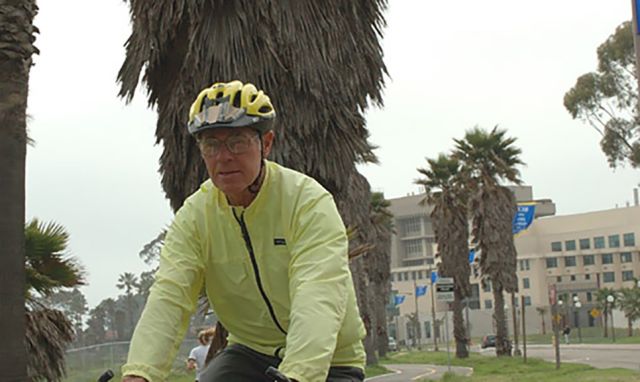
Stan loved his work at UCSB. Even after "retirement", he remained one of the first to arrive at the office every morning, usually by bicycle. He also continued to publish, submitting his last manuscript on May 11, 2015. He was a great resource for students and faculty alike, always actively participating in the daily tea-time discussions. Stan mentored many students and postdocs who now hold prestigious positions around the world. He was a wonderful, beloved colleague and will be deeply missed.
Support the Peale Lecture Fund by making a donation today. You can do this online at UCSB Physics Giving Online; just choose the Peale Lecture Fund as your specific interest. Checks should be made payable to the UC Foundation and can be delivered to Christine Griffin in the UCSB Physics Department Office.
Past Lecturers
2016 Peter Goldreich
2017 Gerald Schubert
2018 Robin Canup
2019 Jean Luc Margot
2020 --
2021 Stephen Kane
2023 Katherine de Kleer
2026 Man Hoi Lee
