
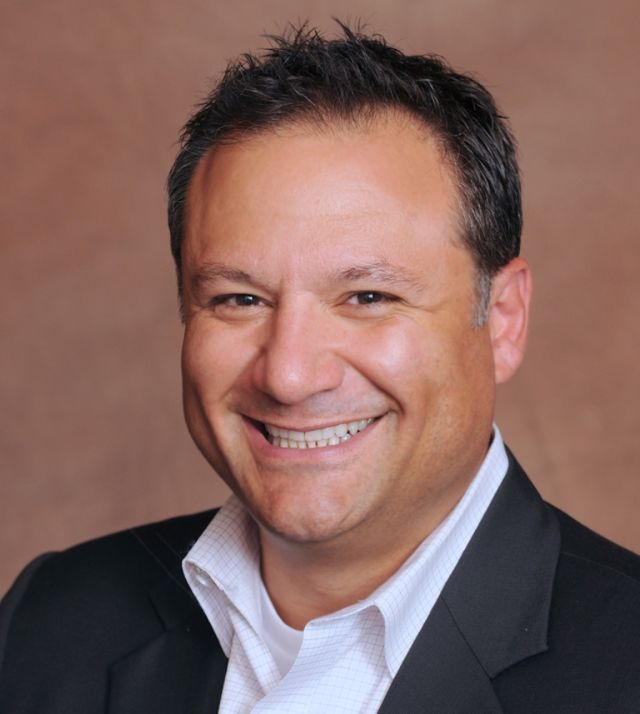
Alumni Spotlight: Joe D’Anna, UCSB PhD 1996
Moving from the world of physics to finance in the ‘90s, Joe D’Anna has had a successful career
applying his love of mathematical puzzles to one of the world’s most complex industries. After
completing his PhD with Tony Zee on random matrix theory in 1996, he transitioned to a career
as a financial engineer, creating new financial products, managing risk and developing systematic
hedging and investment strategies at banks, insurance companies and startups. D’Anna is the
inaugural recipient of the UCSB Physics Alumni Award. Professor Caitlin Casey recently chatted
with D’Anna to learn more about his time at UCSB, his career, and advice for the next generation.
Casey: Congratulations on your alumni award! Tell me a bit about your experience as a UCSB
Physics Grad student.
D’Anna: Thank you! I’m honored and proud to receive this. I’ve always valued staying connected
with UCSB, and this means a great deal. I arrived at UCSB having finished my undergraduate
work at the University of Redlands. My UCSB classmates and I all shared an office and eventually
became close, lifelong friends, but they had graduated from elite research schools like Princeton,
Caltech and Harvard, and I came from Redlands. Some of them initially wondered what I was
doing there, so it took a bit of time to earn their respect. We all got right to work starting the
PhD; it was quite a shock. Santa Barbara is beautiful, but I can say with confidence that I don’t
think I visited the beach or went anywhere fun or interesting probably for the first nine months.
I am really grateful for the broad education, faculty mentoring and research experience I gained
from attending a small, liberal arts college, but my classmates were all a year ahead of me in
physics coursework and I had to catch up. Once we had all bonded, we would do our homework
sets together; studying together was a great experience for me and why many of us are still
close friends.
Casey: What physics problems were you interested in?
D’Anna: I was broadly interested in particle physics and quantum optics when I first arrived at
UCSB. I was on the theory track because I really always have wanted to understand how things
work at a core conceptual level. In my search for a supervisor I noticed that Tony Zee had
published a couple of papers in random matrix theory. It was a side project for him, not his main
focus, so he threw me a problem to go work on to see if I could come up with a solution. I went
away for two or three weeks and dove in, even dreaming about the problem. I did end up
solving it. I went back to Tony and he said I should write it up. I did, then I became his student.
The project was very mathematical, so I enjoyed it greatly, and the work had a lot of potential
applications.
Casey: What drew you to the financial world and investing?
D’Anna: I always loved games, mathematics and puzzles (including physics, of course). I was in
an investing club in high school. I grew up in Carson City, Nevada, and I remember that my
grandfather was interested in the fairness of some of the games in the casino and I played
around by writing some programs to test the statistical properties of gambling results. When I
arrived at UCSB, I was establishing my financial independence, filing taxes, etc. Another
classmate of mine from Redlands happened to also move to Santa Barbara in the math
department. We decided we wanted to learn how to invest, so we started an investment club
with some classmates and friends; I went to mathematical finance journals to try and learn how
I could use my computational mathematical skills to get an edge. This investment club became
something run like a mutual fund, and all of this happened while I was a physics graduate
student.
The more I learned about finance, the more tangible it seemed. Portfolio management can be
understood in the framework of linear algebra and nonlinear optimization problems. I
sometimes would spend my spare time applying portfolio theory to horse bets down at the race
tracks.
The investment club is still going by the way, 30 years later. When we started it was hard to
convince everyone in the club to get an email address so we could all communicate. They’d say,
“email, why do I need that?” It’s funny. Everyone would transfer in $30 a month, and we’d buy
stock in different companies. We’d argue over what to do, but rarely ever sold anything. We
were there to buy stock when Apple was a “beleaguered computer company” on the verge of
collapse, and when Amazon and Google got started. By the 2010s, the club’s portfolio had
become big enough to qualify us as an institutional investor.
Casey: How did you make the transition from physics to the investment world?
D’Anna: I had an office in KITP (at the time, the ITP) as a grad student and would see physicists
older and more advanced in their career move from city to city (or even country to country) in
pursuit of a permanent position. Some were married with families. It seemed like aspects of
that life were going to be really hard. While professors were diligently trying to find their
students postdoctoral positions (which was always appreciated), I also saw that Wall Street firms
were very interested in people with math, computer science, and engineering backgrounds. I
explored some networking and informational interviews with people in the financial industry. I
ended up getting an offer from Bank of America in San Francisco to join a group staffed by nine
other math and physics PhDs.
The hiring manager wanted to talk to my advisor to confirm that I would get the PhD, but I
hadn’t let on to Tony that I was doing this yet. I was nervous about telling him, not sure what he
was going to say. He was actually overjoyed, and maybe even relieved that he didn’t have to find
me a job; I went out and found my own. Because the hiring manager had also been a physicist,
Tony knew him (small world), so they spoke and I got the job. I worked so hard to get my
dissertation done and inside the margin guidelines; I turned it in to the library at 4:59pm on a
Friday, then hopped in a car with my future wife, drove up to San Francisco and started work at
Bank of America on Monday. I flew back for the graduation.
Casey: Do you have any reflections on how finance problems are similar to physics problems?
D’Anna: When I told Tony I was going to Bank of America, we discussed how there were actually
random matrix theory applications in finance. Even now, there was recently a large meeting in
Paris on the topic. When I made the transition I was always looking for ways to make
discoveries. For example, one of my projects was to evaluate the risk in foreign exchange
trading. There’s a trillion dollar market of banks doing this; traders everywhere are completing
transactions in foreign currencies, and each transaction comes with some risk. There are
policies that individual traders need to follow in order to limit how much risk a bank can take on.
I looked at the policy limits. I quickly realized that they analyzed risk along nine dimensions and
put just three linear constraints on it. But there were six other degrees of freedom where risk
could go to infinity. I went to my boss and pointed this out, and the first reaction was that it
couldn’t be true. I drew up some example high-risk transactions, and he admitted I was right.
But then he concluded that ‘traders aren’t smart enough to figure this out, so don’t worry about
it.’ It was one of the first indications I got that my skillset could be very useful, even if in practice
it wasn’t used here.
One way that finance is very different from physics is in how much we can share. Much of what
we do as finance practitioners is proprietary and non-public. Nevertheless, one of the people
I’ve met early in my finance career had also been a former physicist and has eventually became a
mentor and longtime collaborator. And we've published papers over the years in mathematical
finance. I'm grateful for that.
Casey: How has your career changed over the years since that first job in finance?
D’Anna: I was based in San Francisco for just under three years then moved to New York City
where I joined a startup. I’ve worked for various Wall Street firms across banking, insurance,
and asset management. I’ve been a hedge fund and portfolio manager for a mutual fund. It
wasn’t always easy to introduce new ideas in these positions, until I got the opportunity to lead
the quantitative strategy for hedging at an insurance company. There, it felt like I could finally
implement more innovative strategies.
I’m now at Zeconomy. It’s my third startup after swearing off startups. But at a certain point I
realized my entrepreneurial nature and the knowledge, experience and relationships I’d
accumulated had the greatest value on the frontier, in the start-up tackling unsolved problems in
finance and technology. That’s what physicists are trained for: not just finding answers, but
figuring out which questions to ask in the first place. My trajectory has always been about
finding habitats where I’m comfortable. A start-up can deliver that. They’re also genuinely
complex — you’re juggling accounting, legal ramifications across different states or countries,
and taxes, all at once. It’s an environment where someone with a physicist’s mindset can thrive.
Casey: Tell me about your current company, Zeconomy.
D’Anna: Zeconomy is a company that is focused on finding better ways and solving problems
with global commerce, where you have large industrial enterprise companies that have
enormous networks of suppliers. A company like Siemens might have 50,000 different
companies in their supply chain. If they're building a CAT scan machine, the suppliers they
purchase from directly area just the first layer of a network that may be 10 layers deep. Vendors
assemble components from smaller parts and pass them down the chain. Certain invoices along
the way may not be paid until 90 days or more after goods are delivered. These chains are so
complex and production is so critical that companies devote whole departments to
understanding the network of their suppliers and where the risks are: where the credit risk is,
and where the industrial risk is. And from a financial standpoint, the way that the whole system
works is really inefficient and costly. Zeconomy focuses on making the whole process more
efficient by enabling these commercial and financial transactions to exist natively on a
Blockchain (which is a secure digital, tamper-proof ledger).
Casey: What advice would you give PhD students potentially interested in heading into finance?
D’Anna: My basic advice is to seek out informational interviews with professionals in the field
who started from STEM degrees or backgrounds. Be respectful, and ask for 15 minutes with
them. Ask them if they were you at your stage now, what would they do? Use this approach to
build your network and make connections. That’s how industry works — you build personal and
professional connections, and one job leads to the next sometimes. You never know what will
come from those relationships, but you have to show up. It’s something younger folks might
struggle with because they’ve faced some real challenges lately, especially COVID, and the
influence of social media. Don’t underestimate the power of a telephone call or meeting in
person. Talking to people and growing your network can sometimes be uncomfortable, but you
should spend some time building those skills. Even right now — your classmates and professors
— you have relationships with these people, and you will be surprised at how those
relationships will still be important in 10, 20 or 30 years.
Casey: Do you think entering finance now looks different than when you started out?
D’Anna: One big difference is artificial intelligence and machine learning. Until recently,
however impressive the models were, you still had to do tremendous work acquiring and
cleaning data before fitting. With LLMs, the models are powerful enough to even help with that
preparation. But here's the concern: even the experts don't fully understand how any particular
model works, yet people are blindly using them to extrapolate knowledge despite welldocumented
hallucination problems. Physicists and engineers who rely on models know you
have to understand the system, model, and data, evaluate the fit, and be aware of where you
can and can't extrapolate. The rest of the world is barreling ahead without that discipline—and
with LLMs, the consequences aren't just unreliable results, they're potentially dangerous.
And in the era of realistic, hard-to-detect avatars, there’s going to be a much greater premium
put on meeting people, knowing them, and trusting that they're a person that can be relied
upon. I would say it's even more important now to do that kind of old-fashioned networking and
showing up.
For example, I’ve been on the other end of the table running the recruitment for a summer
internship program at Goldman Sachs. I would get a file of 100 applicants that were graduating
with a master’s degree in mathematical finance, or computer science, or physics at Harvard (or
similar Ivy League schools). They all had perfect grades. They were all indistinguishable, like
electrons. What are you supposed to do if you can only interview five? But the kid that actually
called me up or the young person that I met or who was able to hold a conversation… suddenly
they’re ahead of the pack, even if they’re not from a top school. So my best advice is to keep
showing up.
